
Introduction
From ancient dice carved out of bone to modern betting apps running 24 hours a day, humans have always been fascinated by uncertainty. We enjoy testing skill, competing with others, and experiencing the excitement of not knowing what will happen next. This is where the worlds of games and gambling meet. At first glance both look similar — rules, players, outcomes, and rewards — yet the emotions they trigger and the effects they create in human behavior are very different.
Games are built around improvement, strategy, and learning. They reward practice and patience. Gambling, however, revolves around chance, anticipation, and risk. The player is not mastering a system but hoping to outpace probability. Despite this difference, modern technology has blurred the boundary between the two. Video games now include random rewards, while betting platforms use game-like designs to keep users engaged.
Understanding games and gambling is not only about entertainment; it is about psychology. Why do people feel excitement when risking something valuable? Why do losses sometimes encourage further play instead of stopping it? And why has the combination of digital technology and human behavior made this topic more important than ever?
Exploring these questions helps us see that the attraction is not just money or victory — it is the human brain responding to uncertainty itself.
The Psychology of Winning and Losing
When people think about games and gambling, they usually imagine money, entertainment, or competition. But the real engine behind both is emotion. Winning and losing do not affect us only financially — they affect identity, confidence, and memory.
A person who wins a skill-based game feels proud because effort created success. The brain links improvement with reward. Over time this builds patience and discipline. That is why traditional games like chess, sports, or puzzles feel satisfying even after losing. The mind recognizes progress.
Gambling works differently. The outcome is detached from effort, yet the emotional reaction is stronger. A random win creates a powerful story in the brain: “I did something right.” Even when logic knows the result was chance, emotion records it as achievement. This emotional mislabeling keeps the player engaged far longer than expected.
Interestingly, losing in gambling often increases motivation rather than stopping it. The brain believes balance must return — a psychological belief known as fairness expectation. Humans naturally assume results should even out quickly, even though probability has no memory. Each round is independent, yet the mind connects them into a narrative.
Because of this, players often remember the one large win and forget dozens of small losses. The brain stores highlights, not averages. The memory becomes selective and optimistic.
The Role of Environment
Physical surroundings strongly influence gambling behavior. Traditional casinos are designed carefully: no clocks, soft lighting, controlled temperature, and continuous sound. These elements are not accidental. They reduce awareness of time and create comfort, allowing the mind to focus only on play.
Online environments replicate the same effect differently. Instead of architecture, they use interface design:
- Bright reward animations
- Celebratory sounds
- Quick reload buttons
- Instant balance updates
The player never experiences a full stop. Without interruption, decision-making shifts from rational thinking to automatic behavior. Actions become habitual instead of deliberate.
Games also use immersive environments, but usually to enhance storytelling or challenge. Gambling environments exist to extend duration. The longer attention stays engaged, the higher the chance of repeated betting.
Near Misses and Emotional Hooks
One of the most powerful features in gambling systems is the near miss. When the result almost succeeds — one number off, one symbol away — the brain interprets it as progress rather than failure. Emotional intensity rises because the player feels close to control over the outcome.
In reality, near misses are mathematically equal to total losses. But psychologically they are closer to wins. This encourages continuation. The player feels improvement without actually improving.
Games use feedback to teach.
Gambling uses feedback to motivate repetition.
That difference explains why some people spend hours trying again after repeated losses. They are not irrational; they are responding to emotional signals designed to keep them engaged.
Financial Perception vs Real Money
Another important factor is how people perceive money during gambling. In daily life, money represents effort, time, and security. During gambling, it becomes points.
Digital platforms accelerate this change:
- Chips replace currency
- Balances update instantly
- Small bets feel insignificant
Once money turns abstract, risk tolerance increases. Losing ten small bets feels easier than losing one larger payment, even if total value is the same. The mind separates gambling funds from real finances — a mental accounting effect.
Games often use virtual currency too, but players usually understand its purpose as progression. Gambling blurs this boundary because virtual tokens represent real value while feeling unreal.
Personal Responsibility and Awareness
Understanding the difference between entertainment and dependency requires awareness, not avoidance. Gambling itself is not universally harmful; uncontrolled behavior is. Many people participate occasionally without negative impact because they maintain emotional distance from outcomes.
Problems begin when gambling becomes solution instead of activity:
- Playing to recover losses
- Playing to change mood
- Playing to escape problems
At that stage, the behavior shifts from choice to coping mechanism.
Healthy engagement depends on recognizing that uncertainty is enjoyable only when limits exist. When limits disappear, uncertainty becomes stress rather than excitement.
The Digital Revolution of Games and Gambling
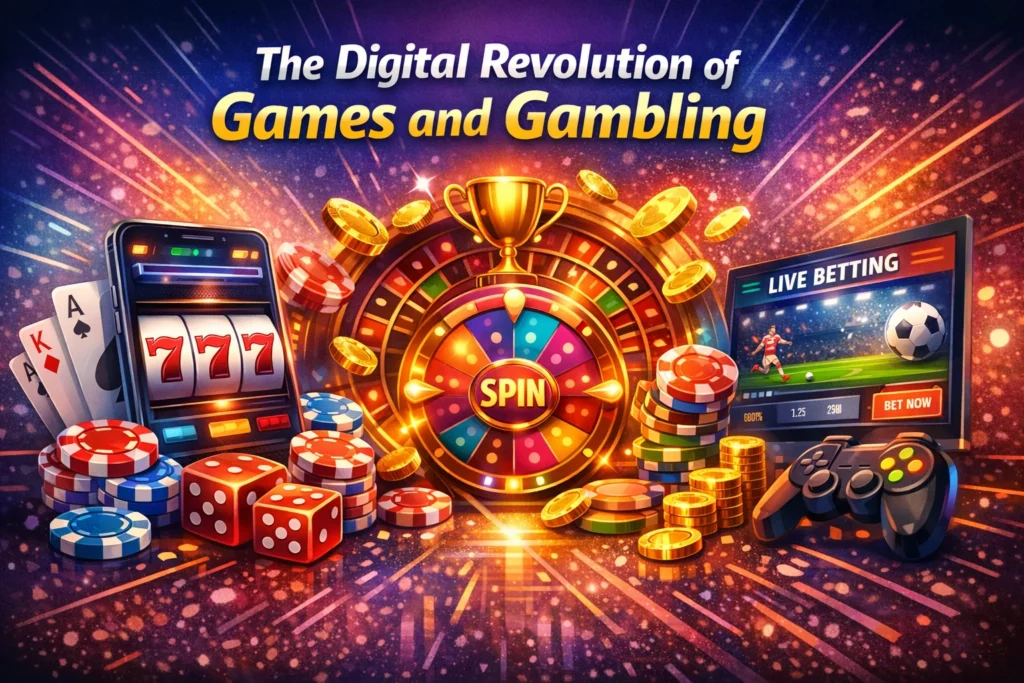
The relationship between games and gambling changed dramatically once entertainment moved from physical locations to digital platforms. In the past, gambling required travel, time, and social presence. A person had to visit a casino, betting shop, or gathering. The effort itself acted as a natural limit. Modern technology removed that barrier. Now games and gambling exist inside the same device that people carry every day.
Online platforms transformed occasional gambling into continuous availability. A player no longer waits for an event; the event waits for the player. This shift altered behavior patterns. Instead of planning to gamble, users now encounter gambling opportunities during normal gaming activity, browsing, or even social interaction. The accessibility of online gaming and online gambling merged entertainment with wagering in a way never seen before.
Mobile interfaces intensified engagement. Quick taps, instant loading, and constant feedback make games and gambling feel similar. Bright animations, progress bars, spinning wheels, reward notifications, and sound effects create a loop of anticipation and action. In traditional games, feedback communicates achievement. In gambling, feedback maintains excitement. The visual language is shared, but the purpose differs.
Digital gaming companies discovered that uncertainty increases attention. As a result, many modern games include randomized reward systems that resemble gambling mechanics. Players open packs, spin wheels, reveal mystery items, or unlock surprise rewards. Although these systems are technically part of a game, psychologically they function like gambling. The user pays for a chance rather than a guaranteed outcome. This blurred boundary expanded the psychological reach of gambling far beyond casinos.
Skill, Chance, and the Blended Experience
In classical definitions, games reward skill and gambling rewards luck. Today the distinction is less clear. Many platforms combine both elements to create a hybrid experience. A player may use skill to reach a stage but rely on chance to obtain valuable rewards. This mixture strengthens engagement because the brain attributes success to ability and failure to probability.
This hybrid structure increases participation:
- Skill encourages confidence
- Chance encourages repetition
The player feels responsible for progress yet hopeful for sudden advantage. Games and gambling reinforce each other. Skill provides justification to continue, and luck provides emotional motivation.
The result is a powerful engagement cycle. Even when outcomes depend mostly on probability, the presence of interaction gives a sense of control. The mind prefers action over randomness, so pressing a button feels meaningful even if the system already determined the result.
Reward Frequency and Behavioral Conditioning
Another major factor linking games and gambling is reward frequency. Humans respond strongly to unpredictable rewards. Predictable rewards create satisfaction, but unpredictable rewards create obsession. Behavioral psychology demonstrates that irregular reinforcement produces the most persistent actions.
Digital systems apply this principle precisely. Instead of providing steady rewards, platforms vary the timing and size of wins. Small successes appear frequently while large successes appear rarely. This balance keeps anticipation alive.
In games, unpredictable rewards create excitement within a progression system. In gambling, they create continuation without progression. The player repeats the same action not to advance but to experience the possibility again.
High-frequency interaction increases immersion. Fast rounds prevent reflection. When decisions occur quickly, emotional thinking dominates logical thinking. The player reacts rather than evaluates. This is why rapid betting formats feel more intense than slower games.
Perception of Value in Virtual Environments
Games and gambling both use virtual representations of value. Coins, credits, chips, tokens, or points replace physical currency. This transformation changes how risk feels. When value becomes symbolic, the emotional weight decreases even if the real cost remains.
A person hesitates before handing over physical money but reacts casually to digital deduction. The brain processes numbers on a screen differently than tangible resources. This psychological distance increases participation and reduces perceived loss severity.
In gaming environments, virtual currency usually measures progress. In gambling environments, it measures risk. Because both appear visually similar, users may subconsciously treat risk as progress. The design similarity contributes to confusion between playing and betting.
Time Perception and Continuous Play
One important aspect of games and gambling is altered time perception. Continuous engagement reduces awareness of duration. Without natural pauses, the mind remains in active mode. Digital platforms avoid interruptions intentionally. Automatic rounds, quick restarts, and seamless transitions encourage ongoing participation.
Traditional games often include natural stopping points such as level completion or match endings. Gambling formats minimize stopping points. A round ends and another begins immediately. The brain never switches fully into evaluation mode.
Extended focus affects decision quality. Short breaks allow rational thought; uninterrupted sequences favor impulse behavior. The environment therefore shapes choice without directly controlling it.
Social Influence and Shared Experience
Modern platforms incorporate social features into games and gambling. Leaderboards, live chats, shared events, and competitive rankings create community involvement. Social visibility increases emotional investment because outcomes affect reputation as well as reward.
When people observe others winning, participation rises. Observational reinforcement works similarly to personal success. The player imagines experiencing the same outcome. Social proof strengthens belief in possibility even when probability remains unchanged.
Games use social interaction to encourage cooperation or competition. Gambling uses it to amplify excitement and normalize risk-taking behavior. Seeing others participate reduces hesitation.
Emotional Cycles and Engagement
The emotional cycle in games and gambling follows a repeating pattern:
- Anticipation
- Action
- Outcome
- Reaction
- Re-engagement
In games, reaction leads to strategy adjustment.
In gambling, reaction leads to repetition.
Because outcomes are uncertain, the anticipation phase becomes the strongest emotional component. The brain focuses on what might happen rather than what already happened. This future-oriented thinking keeps attention engaged continuously.
The Expansion of the Industry
The convergence of digital gaming and online gambling created a massive entertainment sector. Platforms now combine streaming, competition, wagering, and progression systems in one environment. Users may watch, play, predict, and bet within the same session.
This integration changes user expectations. Entertainment is no longer passive. Interaction and risk become part of the experience. The industry grows because engagement increases when uncertainty exists.
The more interactive a platform becomes, the more similar games and gambling appear. The core difference — skill versus chance — becomes harder for users to perceive. Awareness therefore becomes essential for maintaining balance.
Behavioral Economics Behind Games and Gambling
To fully understand games and gambling, we must look at behavioral economics — the study of how people actually make decisions instead of how they should make decisions. Traditional economic theory assumes humans act logically to maximize value. Real behavior shows the opposite. In environments involving risk, reward, and uncertainty, emotion consistently overrides calculation.
One powerful bias is loss aversion. Losing feels stronger than winning feels good. Because of this, players in gambling environments often continue playing after a loss, not to gain profit but to remove discomfort. The mind interprets a loss as incomplete rather than finished. The next attempt feels like closure.
In games, failure motivates learning.
In gambling, failure motivates continuation.
Another bias is the sunk cost effect. After investing time or money, stopping feels like wasting effort. A gambler who has already placed many bets believes quitting now would make previous losses meaningless. So the person continues, hoping to justify past decisions. Ironically, the more losses accumulate, the harder it becomes to stop.
Games also create investment, but they reward persistence with improvement. Gambling rewards persistence only occasionally, yet the psychological pressure is stronger because real value is attached.
The Role of Memory and Storytelling
Human memory does not record events objectively. It records emotional peaks. This explains why experiences in games and gambling feel different when remembered than when measured.
A gambler may lose repeatedly but recall one major win vividly. The mind compresses negative events and expands positive ones. Over time the narrative becomes: “I win sometimes” instead of “I lose overall.”
Games create stories of achievement:
- Level completed
- Skill improved
- Strategy mastered
Gambling creates stories of possibility:
- Almost won
- Nearly hit jackpot
- Lucky day coming
Both are narratives, but one is based on development while the other is based on expectation. The brain prefers hopeful stories, which makes gambling emotionally persuasive even when logically unfavorable.
Speed, Repetition, and Automatic Behavior
High-speed interaction strengthens habits. When actions repeat quickly, the brain shifts from conscious decision-making to automatic response. Many modern platforms design games and gambling rounds to last only seconds. This prevents analytical thinking.
Slower experiences allow evaluation:
“Should I continue?”
Faster experiences trigger impulse:
“Again.”
The shorter the interval between outcome and next opportunity, the less time the brain has to process consequences. Rapid cycles therefore increase participation without explicit encouragement. The system does not force behavior; it accelerates rhythm until reflection disappears.
Personal Identity and Risk-Taking
People often connect risk-taking to personality. Some view themselves as cautious, others as bold. Games and gambling interact with this identity perception.
In games, skill growth reinforces competence. A player sees improvement and builds confidence. Risk becomes calculated.
In gambling, identity may shift toward luck orientation. The player begins believing outcomes reflect personal fortune. Statements like “I’m due for a win” or “Today is my day” show identity merging with randomness.
This psychological shift is powerful. When randomness feels personal, disengagement becomes emotionally difficult. Stopping feels like abandoning a moment of destiny rather than ending an activity.
Entertainment vs Escape
A healthy relationship with games and gambling depends on purpose. Entertainment seeks enjoyment during free time. Escape seeks relief from negative feelings. The external activity may look identical, but internal motivation changes the impact.
Entertainment characteristics:
- Clear start and end
- No emotional dependency
- Outcome does not affect mood for long
Escape characteristics:
- Extended duration
- Mood depends on results
- Difficulty stopping
When gambling becomes emotional regulation, risk increases significantly. The behavior no longer provides excitement; it provides temporary relief. This is the point where awareness becomes essential.
The Future Interaction Between Gaming and Betting
As technology advances, the separation between gaming environments and betting environments will continue shrinking. Virtual worlds, live digital competitions, and interactive spectatorship are merging into unified experiences where watching, playing, and wagering occur together.
This does not mean games will become harmful or gambling will dominate entertainment. It means understanding probability, risk perception, and emotional response will become an important life skill. People will need the ability to recognize when they are pursuing mastery and when they are pursuing chance.
Games train ability.
Gambling tests restraint.
Both will remain part of human culture because both satisfy psychological needs — control and uncertainty. The challenge of the modern era is not eliminating either activity but recognizing the boundary between them.
Regulation, Responsibility, and the Balance Between Games and Gambling
As games and gambling become more interconnected, societies face an important challenge: how to allow entertainment while preventing harm. Regulation is not only about restricting behavior; it is about understanding human psychology and designing environments that respect human limits.
Traditional gambling spaces relied on physical presence, which naturally slowed participation. Online environments removed that barrier, so regulation now focuses on transparency, limits, and informed choice. Many platforms introduce spending caps, session reminders, and probability disclosures. These tools attempt to restore awareness that fast digital interaction often removes.
In games, regulation discussions revolve around randomized rewards and paid chance mechanics. Because these systems resemble gambling patterns, especially for younger audiences, many experts argue users should understand the probability behind rewards. Knowledge does not eliminate excitement, but it reduces illusion.
The key issue is not whether games or gambling exist — both have existed for thousands of years. The issue is whether users understand what type of activity they are engaging in at a given moment.
Psychological Self-Control in a Risk Environment
Managing engagement with games and gambling depends largely on self-regulation. Self-control is not simply willpower; it is awareness combined with structure. People make better decisions when boundaries exist before emotions intensify.
Practical mental strategies include:
- Deciding limits before starting
- Viewing money spent as entertainment cost
- Taking breaks between sessions
- Separating mood from outcomes
- Avoiding decisions immediately after losses
These methods work because emotional peaks reduce analytical thinking. When anticipation rises, judgment narrows. Pre-planned limits protect decisions made during calm thinking from being overridden by excitement.
Games encourage persistence through practice. Gambling encourages persistence through possibility. Recognizing which motivation is active helps maintain balance.
Education and Probability Awareness
Modern life increasingly requires probability understanding. Weather forecasts, financial markets, and digital algorithms all operate on chance patterns. Games and gambling provide direct emotional experience of probability, but without education the lessons can be misunderstood.
People naturally search for patterns even in randomness. The brain evolved to detect structure because it once improved survival. However, in gambling environments this instinct creates false conclusions. Repeated losses feel like they increase chance of winning, while repeated wins feel like a streak will continue. In reality, independent events remain independent.
Teaching probability awareness does not remove enjoyment. Instead, it transforms the experience from belief-based to knowledge-based. A player can still enjoy uncertainty while recognizing it as uncertainty rather than predictability.
Social Responsibility and Community Influence
Communities influence how individuals interact with games and gambling. Social attitudes determine whether participation is casual entertainment or pressured behavior. When discussion focuses only on big wins, perception becomes distorted. Balanced conversation includes both outcomes and expectations.
Healthy social environments:
- Treat gambling as optional leisure
- Do not glorify financial risk
- Encourage breaks and moderation
- Value skill-based play over chance reliance
Because people mirror group behavior, responsible culture reduces harmful patterns naturally. Awareness spreads through conversation more effectively than through restriction alone.
The Personal Boundary Between Play and Risk
Ultimately the difference between games and gambling is internal rather than external. The same activity can be harmless fun for one person and stressful compulsion for another. The deciding factor is intention.
Ask two questions:
- Am I playing for enjoyment or recovery?
- Would stopping now feel neutral or uncomfortable?
If stopping feels difficult, the activity may have shifted from entertainment toward emotional dependence. Recognizing this early allows adjustment before consequences grow.
Games should end with satisfaction.
Gambling should end with acceptance.
When either ends with tension, balance has been lost.
A Sustainable Future for Games and Gambling
The future will not remove uncertainty from entertainment. Humans naturally seek excitement, challenge, and possibility. Instead, progress will focus on clarity. Platforms may continue blending gaming mechanics with wagering elements, but users will benefit from clearer information and stronger personal awareness.
Responsible design and responsible participation work together. Technology shapes behavior, yet understanding shapes choice. When people know why they feel excitement, they can enjoy it without being controlled by it.
The goal is not to eliminate risk — risk gives experiences meaning.
The goal is to recognize risk — recognition gives experiences control.
In that balance, games remain fun and gambling remains optional, allowing both to exist as forms of entertainment rather than sources of harm.
Emotional Cycles and Decision Patterns in Games and Gambling
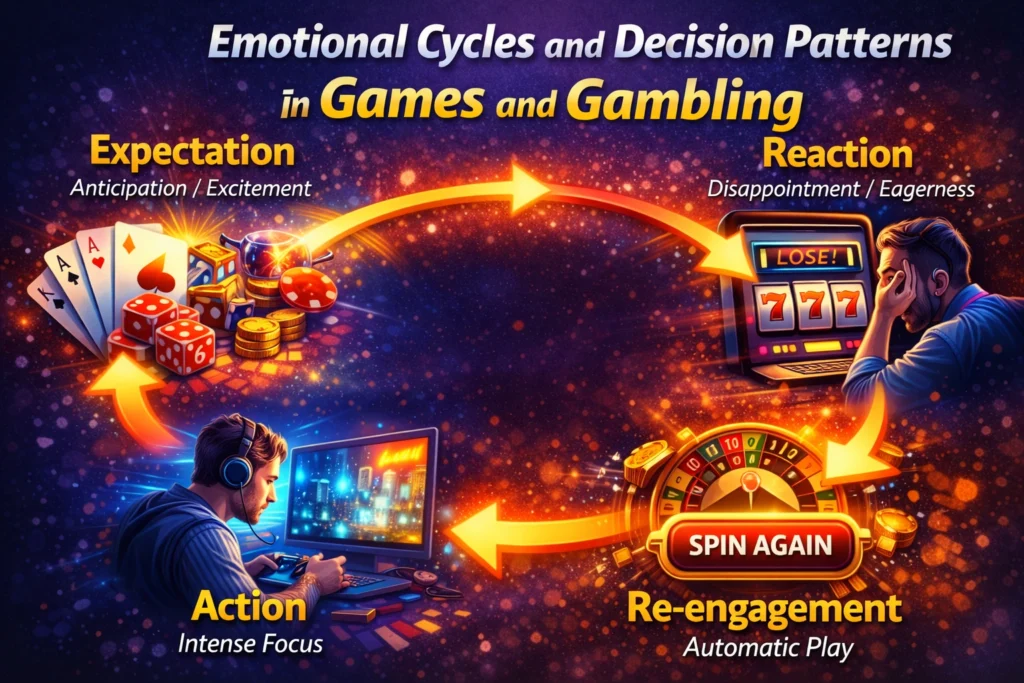
The experience of games and gambling follows a repeating emotional rhythm that strongly influences behavior. This rhythm is not random; it is predictable and rooted in human psychology. Understanding it helps explain why people continue playing even when outcomes are unfavorable.
Every session usually moves through four mental stages:
Expectation → Action → Reaction → Re-engagement
At the expectation stage, anticipation rises. The player imagines a positive outcome before it happens. In games, this expectation relates to achievement or progress. In gambling, it relates to winning or recovery. The mind prepares emotionally before reality appears.
During action, attention narrows. Focus becomes intense, and awareness of time decreases. Fast-paced environments strengthen this effect. Short rounds in both gaming and betting systems prevent distraction and maintain emotional momentum.
The reaction stage differs greatly between games and gambling.
In games, the player evaluates performance: What can I improve?
In gambling, the player evaluates possibility: What might happen next?
This difference determines the next decision. Instead of ending the session, the brain seeks another round to complete the emotional loop. Re-engagement begins automatically because anticipation restarts immediately after an outcome.
Chasing Balance and the Need for Closure
Human thinking prefers balance. When something feels incomplete, the brain seeks resolution. This tendency strongly affects gambling behavior.
After a loss, the mind experiences tension. Continuing play feels like a way to restore equilibrium. The person is not always chasing profit — often they are chasing emotional closure. Winning appears to cancel the discomfort created by losing.
Games provide closure naturally through progress markers such as levels, scores, or completion screens. Gambling rarely provides closure because each result stands alone. Without a clear ending, the session extends longer than intended.
The search for balance creates repeated participation:
- A loss invites correction
- A win invites confirmation
Either outcome encourages continuation, which explains why stopping at the planned time can feel unexpectedly difficult.
Attention Capture and Cognitive Load
Modern systems of games and gambling are designed around attention capture. The brain has limited processing capacity, so intense sensory input reduces reflective thinking. Bright visuals, rapid motion, and sound feedback occupy mental resources, leaving little room for analysis.
When cognitive load increases:
- Decisions become faster
- Evaluation becomes shallow
- Habits override planning
Games use this immersion to enhance enjoyment and challenge. Gambling environments use it to sustain engagement. Because the player remains mentally occupied, they delay reconsidering participation.
The mind interprets constant activity as meaningful involvement even when outcomes rely mainly on chance.
Reward Anticipation vs Reward Experience
Interestingly, anticipation often feels stronger than the reward itself. The moment before the result produces the highest emotional intensity. This applies equally to games and gambling but influences behavior differently.
In games, anticipation leads to satisfaction after success because effort connects to outcome.
In gambling, anticipation restarts immediately after outcome because effort does not resolve uncertainty.
The player returns not only for winning but for the feeling just before winning. The emotional peak exists in possibility, not possession.
Habit Formation and Routine Play
Repeated exposure transforms occasional activity into routine. Habits form when actions require little conscious thought. Both games and gambling can become part of daily patterns, especially when accessible through mobile devices.
A routine begins harmlessly:
- A quick session for relaxation
- A brief distraction during free time
Over time the brain associates specific moods with the activity. Boredom, stress, or curiosity trigger automatic participation. The person may not actively decide to play; the environment cues the behavior.
Awareness breaks this cycle. Recognizing triggers allows intentional choice instead of automatic response.
Ending the Session: The Most Important Decision
Starting a session is easy. Ending it is psychologically harder. The final decision defines whether engagement stays entertainment or becomes compulsion.
In games, stopping often feels natural after completion.
In gambling, stopping often feels premature because uncertainty remains unresolved.
Creating a personal stopping rule — time-based rather than outcome-based — helps maintain balance. When the endpoint depends on result, continuation becomes endless because the desired result may always feel one step away.
The healthiest interaction with games and gambling occurs when the player controls the ending, not the outcome.
Frequently Asked Questions (FAQ) – Games and Gambling
1. What is the main difference between games and gambling?
The main difference between games and gambling is the role of skill versus chance. Games depend mostly on learning, strategy, and improvement over time, while gambling depends mainly on randomness and probability. In games, players can become better with practice. In gambling, outcomes remain uncertain regardless of experience.
2. Why do people enjoy gambling even when they lose?
People enjoy gambling because anticipation activates the brain’s reward system. The excitement of a possible win feels powerful even without actual profit. In games and gambling, the emotional experience often matters more than the financial result. The brain remembers moments of excitement more strongly than repeated small losses.
3. Can gaming become similar to gambling?
Yes, modern digital entertainment has blurred the line between games and gambling. Some games include randomized rewards, mystery items, or chance-based purchases. These features create similar emotional responses to gambling because players pay for uncertain outcomes rather than guaranteed rewards.
4. Is gambling always harmful?
Gambling is not automatically harmful. Like many forms of entertainment, its impact depends on control and intention. Games and gambling become risky when a person tries to recover losses, escape stress, or relies on winning for emotional relief instead of treating it as leisure activity.
5. Why do players keep playing after losing?
After losing, the brain seeks balance and closure. Many people believe another attempt will correct the result, even though probability does not remember past outcomes. This psychological effect is common in games and gambling but stronger in gambling because outcomes rely on chance rather than improvement.
6. Do near misses encourage more gambling?
Yes. Near misses feel similar to wins in the brain. When players almost succeed, they believe success is getting closer. In gambling environments this encourages repetition, while in games near misses usually encourage learning and skill adjustment.
7. How can someone play responsibly?
Responsible interaction with games and gambling includes setting limits before playing, taking breaks, accepting losses as final, and separating entertainment spending from essential money. Planning decisions before emotional excitement begins helps maintain control.
8. Why does online gambling feel more engaging than traditional gambling?
Online platforms remove natural stopping points. Instant rounds, fast feedback, and constant availability increase immersion. Digital design keeps attention focused continuously, making games and gambling feel faster and more intense than physical environments.
9. Are games safer than gambling?
Generally, games are safer because progress depends on skill and improvement. Gambling carries financial risk because outcomes are unpredictable. However, excessive play in either activity can affect time management and habits if not balanced.
10. Can understanding probability reduce risky behavior?
Yes. Learning how probability works helps people recognize that past results do not influence future outcomes. Awareness allows players to enjoy games and gambling as entertainment instead of expecting guaranteed wins.
Conclusion
The relationship between games and gambling is ultimately a relationship between control and chance. Games reward effort, learning, and patience, while gambling rewards risk, anticipation, and emotional excitement. As technology evolves, the boundary between the two continues to narrow, making awareness more important than ever. A player today may move from gaming to betting within the same environment without realizing the psychological shift that has occurred.
Modern platforms have made games and gambling constantly accessible. This accessibility increases engagement but also increases responsibility. Understanding probability, recognizing emotional triggers, and setting personal limits allow entertainment to remain enjoyable instead of stressful. When users treat outcomes as experience rather than expectation, participation stays balanced.
Digital environments such as lemonbook demonstrate how interactive entertainment continues to grow, combining excitement with convenience. At the same time, exploring different platforms like goexch9 shows how wagering systems expand across the online space. The key difference lies not in the platform but in the mindset of the participant.
Healthy interaction with games and gambling means playing for enjoyment, not recovery; curiosity, not dependency; excitement, not escape. The moment a person understands why they feel the urge to continue is the moment control returns to the player. In the end, success is not measured by winning or losing — it is measured by stopping at the right time.
 Get WhatsApp ID Now