

Introduction
betting activity are one of the oldest forms of entertainment created by humans. Long before modern casinos, mobile apps, or online platforms existed, people were already wagering on outcomes — from dice rolls and card matches to races and competitive sports. The basic idea has always remained simple: predict an uncertain result and place something valuable on that prediction. Sometimes the reward is money, sometimes pride, and sometimes just the thrill of being right.
What makes online betting activity unique is the mixture of excitement and uncertainty they produce. Unlike ordinary games where the result depends mostly on skill, betting introduces risk. A person never knows for sure what will happen next, and that unpredictability is exactly what attracts people. The moment between placing a bet and discovering the outcome creates anticipation, tension, and emotional involvement that many other activities cannot provide.
Over time, betting has evolved from small social wagers into a global entertainment industry. Today it includes casino games, sports predictions, card tables, and friendly bets between friends. Technology has changed the format, but the human motivation remains the same — curiosity about chance and the desire to test luck.
This article looks at betting games not only as a form of gambling but as a psychological and social activity. By understanding why people bet, how games work, and how risk influences behavior, it becomes easier to see betting as more than just winning or losing money. It is, in many ways, a reflection of human nature and our fascination with uncertainty.
The Psychology Behind online Betting Decisions
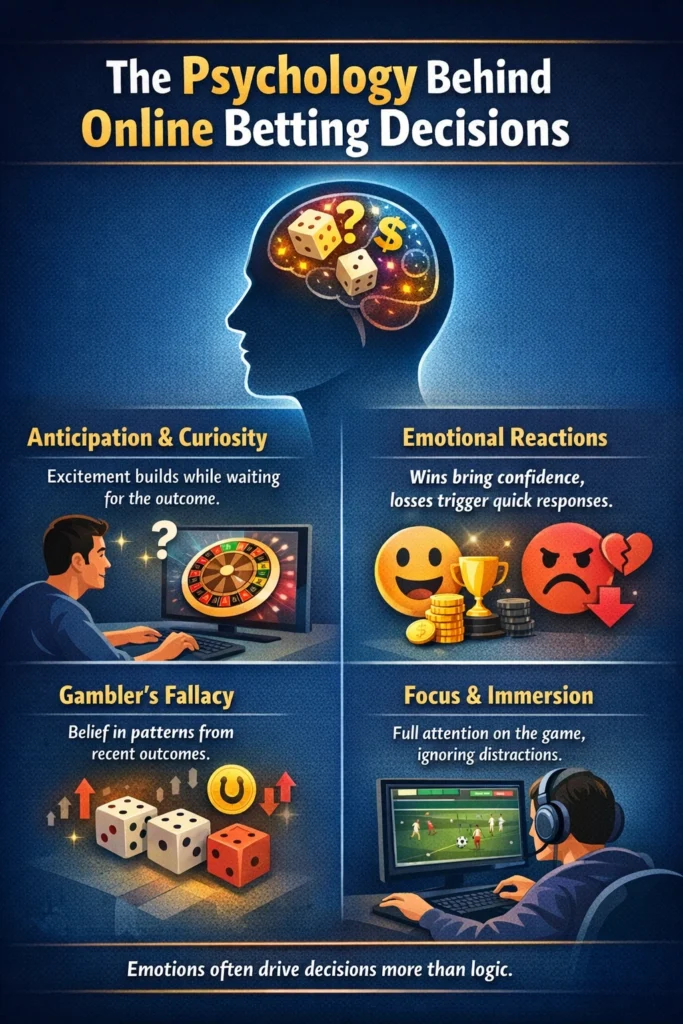
Understanding betting games requires more than knowing the rules. To truly understand why people participate in them, it is important to look at the psychology behind decision making. Betting is rarely just a logical activity. It is strongly influenced by emotions, perception, and cognitive biases.
When someone places a bet, they are not only calculating odds. They are also experiencing hope, confidence, fear, and anticipation. These emotional factors often influence decisions more than statistics do. Even when players know the risks, the excitement of possibility can override rational thinking.
Risk and Reward Connection
Human beings are naturally wired to respond to potential rewards. The brain releases dopamine when we anticipate something positive. Interestingly, dopamine is triggered more strongly by uncertain rewards than guaranteed ones. That is why betting games feel so engaging. The uncertainty creates a stronger emotional reaction than a predictable outcome.
For example, receiving a fixed salary feels stable but routine. Winning a bet feels powerful because it was uncertain. The mind interprets it as an achievement rather than just income. This emotional difference explains why even small wins can feel extremely satisfying.
Cognitive Biases in Betting
Betting decisions are often shaped by mental shortcuts known as cognitive biases. These biases are automatic thought patterns that influence judgment.
One common example is the gambler’s fallacy. This occurs when a person believes that past outcomes affect future independent events. For instance, if a coin lands on heads several times, someone may assume tails is “due,” even though each flip is independent.
Another bias is confirmation bias. A bettor may focus only on information that supports their prediction while ignoring contradictory evidence. If someone believes a team will win, they may only remember past victories and overlook weaknesses.
There is also the overconfidence effect. After a few successful bets, players may overestimate their skill level and take larger risks. This can lead to bigger losses if luck changes.
Emotional Influence on Strategy
Emotions often affect betting strategies. After a win, players may feel confident and increase their stakes. After a loss, they might try to recover quickly by placing another bet. Both reactions are emotionally driven rather than strategically planned.
The desire to recover losses, often called “chasing,” is especially powerful. Instead of accepting a loss as part of the experience, some players attempt to regain money immediately. This behavior increases risk and reduces rational thinking.
The Role of Excitement and Entertainment
Not all betting behavior is negative. Many people participate purely for entertainment. The thrill of uncertainty adds excitement to watching sports or playing games. A small wager can make an ordinary event feel more engaging.
In such cases, betting functions similarly to paying for a movie ticket or theme park ride. The money spent is the cost of entertainment, and any win is a bonus rather than an expectation.
Understanding the Mindset
Recognizing the psychological factors behind betting helps individuals make more informed decisions. When players understand that emotions and biases influence their choices, they can approach betting with greater awareness.
The key difference between controlled entertainment and problematic behavior often lies in self-awareness. Knowing why you are placing a bet — whether for fun, excitement, or emotional reaction — can change the outcome of the experience.
Betting games are not just systems of chance and numbers. They are deeply connected to human psychology. By understanding the mental processes involved, individuals can view betting as a structured form of entertainment rather than a guaranteed method of earning money.
Types of Betting activity and How They Work
Betting games exist in many formats, and each betting game follows a different structure of odds, payouts, and risk levels. Understanding the different types of betting games helps a player approach betting games with clarity rather than confusion. Some betting games depend mostly on luck, while other betting games involve prediction, observation, and decision-making. The popularity of betting games continues to grow because players can choose betting games that match their comfort level and interest.
Casino betting activity
Casino betting activity are the most recognized category of betting activity. In casino betting games, players place wagers against a system rather than another player. The rules of casino betting games are fixed, and the probability inside casino betting games is already calculated by design.
Common casino betting activity include roulette, slots, baccarat, and dice tables. In these betting games, outcomes are generated randomly, which means no player can control the result of betting games in the long run. Players may win short sessions in casino betting games, but over time the structure of betting games ensures balanced payouts.
Casino betting activity attract players because casino betting games are simple to understand. A person does not need deep strategy knowledge to enjoy casino betting games. The excitement in casino betting games comes from instant results and repeated rounds. Fast outcomes make casino betting games engaging and visually stimulating.
Card Based betting activity
Card betting activity are different from pure chance betting activity because card betting games combine luck and skill. In card betting games, players compete with each other instead of only facing the system. Examples of card betting games include poker variations, rummy variations, and traditional table card wagering formats.
In card betting activity, probability awareness improves performance over time. Skilled players in card betting games analyze patterns, observe behavior, and manage risk. While luck still affects short sessions in card betting games, long-term results in card betting games often depend on discipline and decision quality.
Card betting activity also introduce psychological elements. Bluffing, reading reactions, and timing wagers all influence card betting activity. Because of this, many experienced participants prefer card betting games over purely random betting games.
Sports Betting Games
Sports betting activity are prediction-based betting activity. In sports betting games, players wager on real-world events rather than random outcomes. Football matches, cricket games, basketball tournaments, and racing events are common in sports betting activity.
In sports betting activity, analysis plays an important role. Participants study statistics, player form, and historical performance before placing bets in sports betting games. However, sports betting games still contain uncertainty because human performance cannot be perfectly predicted.
Sports betting activity create strong emotional involvement. Watching a live match becomes more intense when a person has placed a prediction in sports betting games. This emotional connection is one reason sports betting activity remain extremely popular worldwide.
Online and Digital betting activity
Technology has introduced online betting games that operate through mobile devices and computers. Online betting games allow players to access betting games at any time without visiting physical locations. Live betting games, virtual betting games, and instant result betting games are all part of online betting games.
Online betting games provide speed and convenience. A player can switch between multiple betting games within minutes. Because online betting games deliver fast outcomes, they increase engagement and repetition compared to traditional betting games.
Online betting games also include social interaction. Many platforms offer chat rooms, leaderboards, and shared predictions. This transforms betting games into community-based entertainment rather than isolated activity.
Casual and Social betting activity
Not all betting games involve formal systems. Casual betting games occur between friends or groups during daily activities. Examples of casual betting games include guessing scores, predicting outcomes, or friendly wagers.
In casual betting games, the reward is often symbolic rather than financial. A meal, treat, or small favor may replace money in casual betting games. These betting games focus on enjoyment rather than profit.
Casual betting games demonstrate that betting games are part of social behavior. People naturally enjoy making predictions, and betting games simply formalize that instinct.
Each category of betting games offers a different experience. Some betting games emphasize luck, some betting games emphasize skill, and some betting games emphasize prediction. By understanding how various betting games function, participants can choose betting games that align with their expectations and comfort level rather than relying only on impulse.
Risk, Probability, and Understanding Outcomes
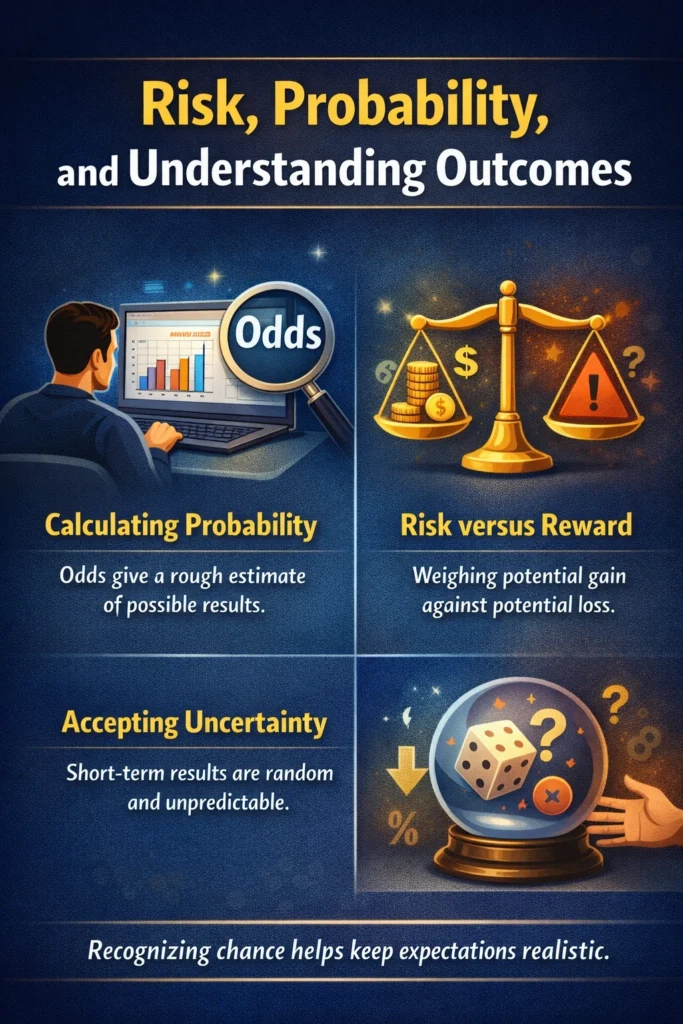
Every betting activity revolves around uncertainty. No matter how simple or complex a game appears, the final result always depends on probability. Many people focus only on winning or losing in a single round, but the real nature of wagering becomes clearer when viewed over a long period of time.
Probability is simply the chance that a particular outcome will occur. In some games the probability is obvious, like a coin toss. In others it is hidden behind systems, statistics, or player performance. Regardless of the format, the outcome cannot be guaranteed. A person may experience several wins in a row, while another may face repeated losses, even when both follow the same approach.
One important concept is that short-term results can be misleading. A player might feel skilled after a few successful predictions, but those results could be random. True patterns only appear across many attempts. This is why people often misunderstand risk. The human mind naturally searches for meaning in recent events, even when the events are independent of each other.
Another common misunderstanding involves recovery after loss. Many believe that a loss increases the chance of a future win. In reality, each round starts fresh. Previous results do not influence the next outcome. Accepting this idea helps reduce emotional decisions and encourages a calmer approach.
It is also useful to separate expectation from possibility. A large reward is possible, but not necessarily likely. The excitement comes from possibility, while frustration often comes from unrealistic expectation. When individuals understand this difference, they begin to see wagering as a form of uncertain entertainment rather than a predictable source of gain.
Learning to think in terms of averages instead of single moments changes perspective. Over time, outcomes follow mathematical balance, not personal luck. Recognizing this helps people make decisions with patience and awareness instead of impulse.
In the end, understanding probability does not remove the thrill. It simply places the experience in a realistic frame. The activity becomes easier to enjoy when the focus shifts from chasing results to observing how chance naturally behaves.
Responsible Participation and Personal Control
Enjoyment depends largely on balance. Any activity that involves uncertainty can remain fun when approached with clear limits. The key is deciding boundaries before starting rather than reacting during emotional moments.
Setting a fixed budget is helpful because it turns the experience into planned spending instead of an open-ended commitment. Once that limit is reached, stopping becomes part of the plan rather than a difficult decision. Time limits work in a similar way. Taking breaks keeps the mind relaxed and prevents frustration from building.
Emotions often influence choices more than logic. After a positive outcome, confidence may increase; after a negative one, the urge to recover can appear. Both reactions are natural, but acting immediately on them usually leads to poor judgment. A pause allows thinking to return to normal.
It also helps to treat the activity as entertainment rather than income. Just like watching a film or attending a match, the value comes from the experience itself. Any reward should feel like a bonus, not an expectation.
Awareness is the strongest safeguard. When a person notices irritation, urgency, or pressure, stepping away is usually the healthiest response. Walking away is not losing control — it is exercising it.
Maintaining balance ensures the experience stays enjoyable, social, and voluntary. With clear limits and calm decisions, the activity remains what it was meant to be: a moment of excitement within everyday life rather than something that takes it over.
Frequently Asked Questions
What are betting games in simple terms?
They are activities where a person predicts an outcome and places something of value on that prediction. The result may or may not match the expectation.
Are outcomes guaranteed?
No. The result is uncertain every time. Past rounds do not decide the next one.
Do skills always make a person win?
Not always. Knowledge can help in some situations, but chance still plays a role. Short-term success does not prove long-term advantage.
Why do people enjoy them?
The excitement comes from waiting for the result. The anticipation often feels stronger than the reward itself.
Is it possible to control participation?
Yes. Setting limits on time and spending keeps the activity manageable and relaxed.
Should they be treated as income?
It is safer to view them as entertainment. Any gain should feel like a bonus rather than a plan.
When should someone stop?
If frustration, urgency, or pressure appears, taking a break is a good decision.
Can understanding probability help?
Yes. Knowing that each round is independent helps reduce emotional reactions and unrealistic expectations.
Conclusion
Uncertainty has always been a natural source of curiosity for people. The attraction does not come only from the final result but from the moments leading up to it — the waiting, the guessing, and the feeling that anything could happen. When approached with a calm mindset, the experience remains light and engaging instead of stressful.
Different platforms simply provide different environments for participation. Some users explore fantasy prediction formats through Dream11 (dream11) while others read guides, information, and related content on Lemonbook (lemonbook). These spaces do not change the core idea. The activity stays the same; only the setting changes.
Balance plays the most important role. Expectations that stay realistic prevent frustration. Small limits make decisions easier. Stepping away when emotions rise keeps the experience comfortable. Over time, a person begins to notice that enjoyment comes more from involvement than from outcome.
It also helps to remember that chance never promises a pattern. Good moments and bad moments appear naturally and then pass. Treating each round as a separate event keeps thinking clear and prevents unnecessary pressure. Patience creates a healthier perspective than urgency.
For many people, the value lies in engagement — watching an event more closely, discussing predictions with friends, or simply passing time with mild excitement. When viewed this way, the activity remains voluntary entertainment instead of obligation. Wins feel pleasant, and losses feel temporary.
Ultimately, a relaxed approach allows the experience to stay in its proper place within everyday life. With awareness and moderation, participation remains enjoyable, social, and controlled. The purpose is not to rely on the outcome, but to appreciate the moment of possibility that comes before it.
 Get WhatsApp ID Now